
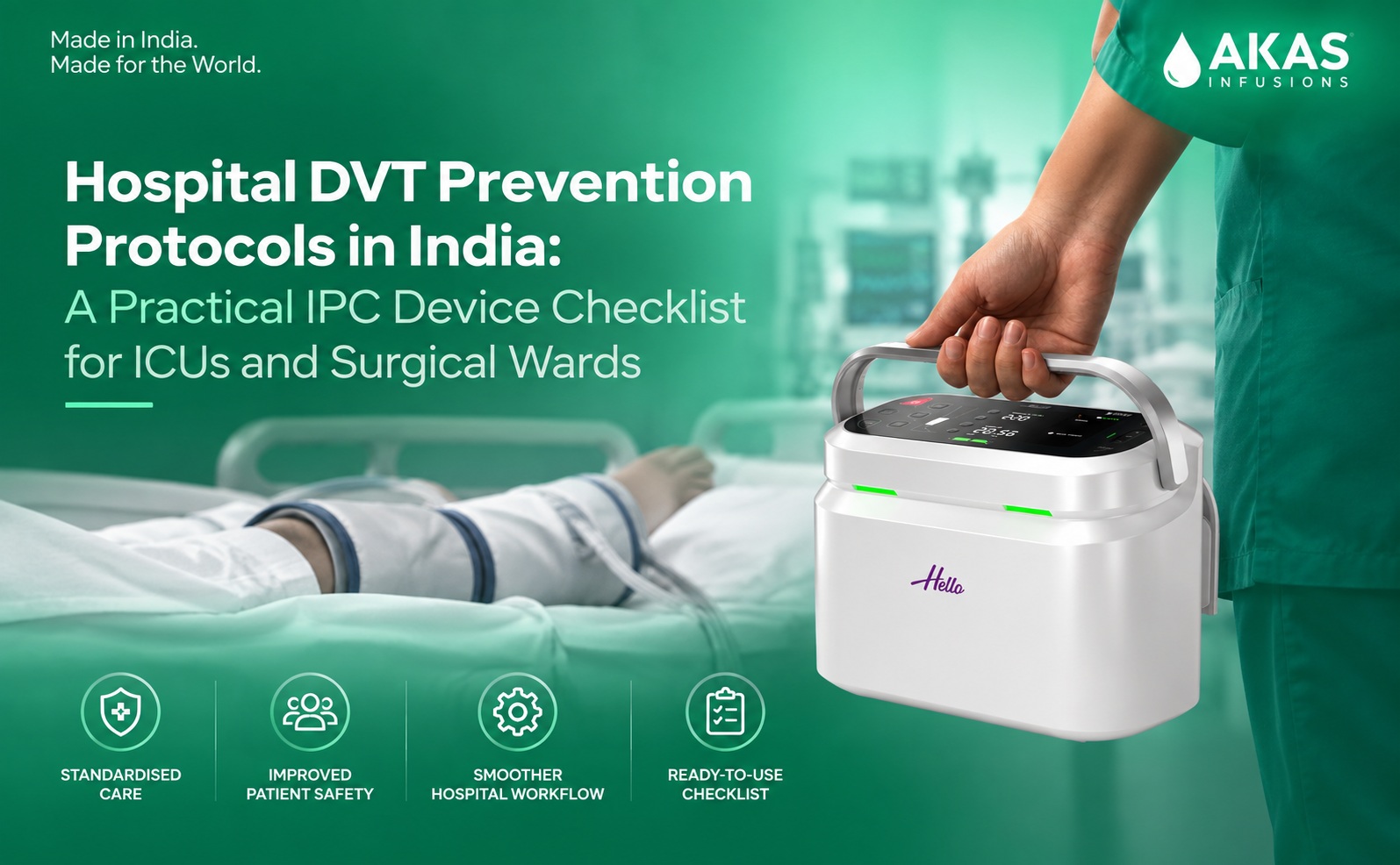
Ward teams often miss the first window to start compression therapy, and the delay shows up later as swelling, pain, or a sudden desaturation scare in the ICU. This is a workflow issue, not a knowledge gap.
This guide turns DVT prevention in hospitals into an actionable nursing checklist for Intermittent Pneumatic Compression. It maps cleanly to Indian hospital routines across pre-op, intra-op, and post-op care, so teams can apply the protocol without slowing surgery lists or ICU timelines.
Want a ward-ready IPC checklist mapped to your theatre and ICU workflow? Speak with our clinical team for a quick review and device demo.
Why DVT prevention protocols matter
Timely DVT prevention in hospitals reduces avoidable harm in high-risk groups, especially after major surgery and immobilisation. A clear IPC device process standardises care across shifts, supports patient safety, and keeps surgical wards and the Intensive Care Unit aligned on responsibilities.
IPC device basics for clinical teams
An IPC device, sometimes called a pneumatic compression device or sequential compression device, intermittently inflates sleeves on the legs or feet to promote venous return. This compression therapy for DVT prevention is non-invasive and is often combined with pharmacological prophylaxis when not contraindicated. In many perioperative pathways, sleeves are applied before induction and continued through recovery until full ambulation.
Practical IPC device checklist: pre-op to post-op
The checklist below is written for ICUs and surgical wards, with clear handovers between anaesthesia, nursing, and recovery teams.
Pre-operative screening
- Verify risk and orders: confirm VTE risk assessment, prescribed modality, and limb selection in the chart. Clarify if mechanical prophylaxis is sole therapy or combined with anticoagulation.
- Check contraindications: look for active DVT, severe peripheral arterial disease, limb ischaemia, decompensated heart failure, severe skin injury, or recent vascular graft to the limb. See the full contraindications section below.
- Measure and size: choose sleeve size using manufacturer guidance. Recheck if the patient has oedema or obesity.
- Plan line placement: avoid placing sleeves on a limb with an arterial line, fragile graft, or where major IV Infusion Device lines must remain accessible. Coordinate with anaesthesia and nursing to protect venous access sites.
Intra-operative application
- Apply and secure sleeves: ensure correct orientation, full contact, and no folds. Check skin integrity before placement.
- Route tubing safely: keep lines off the floor, away from heat sources, and clear of the surgical field.
- Confirm device settings: select the ordered mode on the IPC device and verify indicator lights or screen prompts. Document baseline function before draping.
- Integrate with other devices: if fluid warming or multiple infusions are planned, confirm tubing paths do not compress or kink alongside a Fluid Warmer Machine or an Infusion Pump for Hospital Use.
Post-operative care
- Restart promptly: resume compression on arrival to PACU or ICU unless there is a new contraindication, bleeding concern, or vascular access change.
- Skin and circulation check: inspect heels, calves, toes, and distal pulses at handover. Reassess sizing if swelling has changed.
- Mobility plan: pair IPC use with early physiotherapy. Remove sleeves only for skin care or ambulation as ordered, then reapply without delay.
- Documentation: record start time, limb, device mode, and skin checks in the post-operative care notes.
Daily nursing checklist
- Device running: confirm sleeves are inflating with a visible cycle and audible or visual indicators.
- Skin inspection: check every 8 to 12 hours for redness, maceration, blisters, or pressure areas. Offload heels as needed.
- Limb assessment: check warmth, colour, sensation, and pain. Escalate calf tenderness or asymmetry urgently.
- Lines and dressings: ensure IPC sleeves do not dislodge catheters or dressings. Coordinate with infusion therapy to avoid disruption to IV therapy.
- Hygiene: clean sleeves between patients as per Safety Instructions and hospital policy.
- Documentation: chart hours of use, any breaks, and reasons. Record patient education provided.
Contraindications and cautions
Mechanical compression is not appropriate for every patient. Common contraindications include suspected or confirmed DVT, severe peripheral arterial disease, limb ischaemia, acute skin infection or dermatitis under the sleeve, severe cardiac failure with fluid overload, and limb conditions where compression could compromise a graft or wound. Use clinical judgement for neuropathy, fragile skin, or recent orthopaedic fixation. When in doubt, consult vascular or the operating surgeon before applying an IPC device.
Choosing a DVT pump for hospitals
When evaluating a DVT pump for hospitals, focus on safety, usability, and serviceability:
- Modes and chambers: consider single-chamber intermittent compression or sequential multi-chamber options, depending on patient mix.
- Alarms and indicators: look for clear alarms for disconnection, low pressure, and sleeve faults.
- Ease of cleaning: smooth, wipeable surfaces and sleeves compatible with hospital disinfectants.
- Portability and power: stable stands, quick-release sleeves, and reliable battery backup for transfers.
- Sizing and accessories: calf, thigh, or foot sleeves available, plus Infusion Pump Accessories management to route lines safely.
- Compliance and certification: ensure regulatory approval and alignment with Medical Device Standards and Safety Standards.
- Support: training, Maintenance, spare sleeves, and service SLAs that fit Hospital operations.
Akas Infusions is an Authorized Distributor for compression systems and supports hospitals with protocol adoption, training, and device lifecycle planning. For product detail, see the HELLO DVT Pump.
Documentation, training, and asset tracking
Consistent documentation underpins Compliance and audit. Standardise the nursing checklist, embed it into the EMR, and add a daily verification for hours of therapy and skin status. Schedule refresher training for new staff in ICU, Oncology, and surgical wards. Use Asset Tracking with QR Code Integration so teams can scan, locate, and assign devices, improving Asset Utilization and reducing missed prophylaxis due to unavailable pumps. Clear ownership for Infusion Pump Support and IPC device maintenance streamlines uptime.
Sequential vs single-chamber compression
| Feature | Single-chamber IPC | Sequential compression device |
|---|---|---|
| Compression pattern | Uniform intermittent inflation | Distal-to-proximal multi-chamber sequence |
| Typical use | General prophylaxis | Higher-risk or oedematous limbs |
| Sleeve options | Calf or foot | Calf, thigh, or foot with multiple cells |
| Potential benefits | Simpler setup, fewer parts | Enhanced venous return in many scenarios |
| Considerations | May be less effective for some patients | Slightly more complex setup and sizing |
Choice should reflect patient risk, limb size, and clinician familiarity, as well as the hospital’s protocol and available training resources.
Implementation tips for Indian ICUs and surgical wards
- Build into the pre-anaesthesia checklist so sleeves reach theatre with the patient.
- Keep a small surge stock on each surgical floor to avoid delays after hours.
- Use colour-coded bins for clean versus used sleeves to support infection control.
- During Critical Care admission, assign IPC responsibility to the Nursing Manager on duty to avoid gaps during handovers.
- Align anticoagulation timing with compression use. Review infusion plans that increase bleeding risk, and coordinate with ICU Drug Infusion Management to minimise interruptions.
For broader infusion infrastructure planning and cross-device workflow alignment, explore our Infusion Blog for hospital-ready guides and updates.
Frequently asked questions
When should IPC sleeves be started for DVT prevention after surgery?
Ideally, sleeves are applied before induction and continued through recovery until the patient is fully mobile, unless a new contraindication appears. Restart promptly in PACU or ICU after checks.
Are IPC devices safe for patients on anticoagulants?
Yes, mechanical prophylaxis is commonly combined with pharmacological agents when bleeding risk is acceptable. Always follow the surgeon’s orders and review active bleeding or haematoma risk.
What are the main contraindications to IPC use?
Suspected or confirmed DVT, severe peripheral arterial disease, limb ischaemia, acute skin infection under the sleeve, severe heart failure with overload, or limb grafts that compression could compromise.
How often should skin be checked under IPC sleeves?
Inspect skin every 8 to 12 hours and at each handover for redness, blistering, maceration, or pressure injury. Reassess sizing if oedema or limb circumference changes.
Which is better, a sequential compression device or single-chamber IPC?
Sequential systems provide a distal-to-proximal wave that many teams prefer for higher-risk patients. Single-chamber devices are simpler and can be suitable for routine prophylaxis.
Can IPC be applied on a limb with IV lines or dressings?
Avoid compressing over fragile dressings, arterial lines, or graft sites. Coordinate with infusion therapy to route lines safely and choose the opposite limb when possible.
How do we ensure device availability across wards?
Use Asset Tracking with QR codes, assign ownership for cleaning and returns, and maintain a small buffer stock per floor. This reduces delays and missed prophylaxis.
Reliable DVT prevention in hospitals depends on clear roles, a simple nursing checklist, and equipment that is clean, working, and nearby. With standardised IPC workflows and regular training, ICUs and surgical wards can reduce preventable complications while keeping theatres and recovery moving on time.
Set up a short consultation to review your IPC protocol and request a HELLO DVT Pump demonstration for your ICU or surgical ward.