
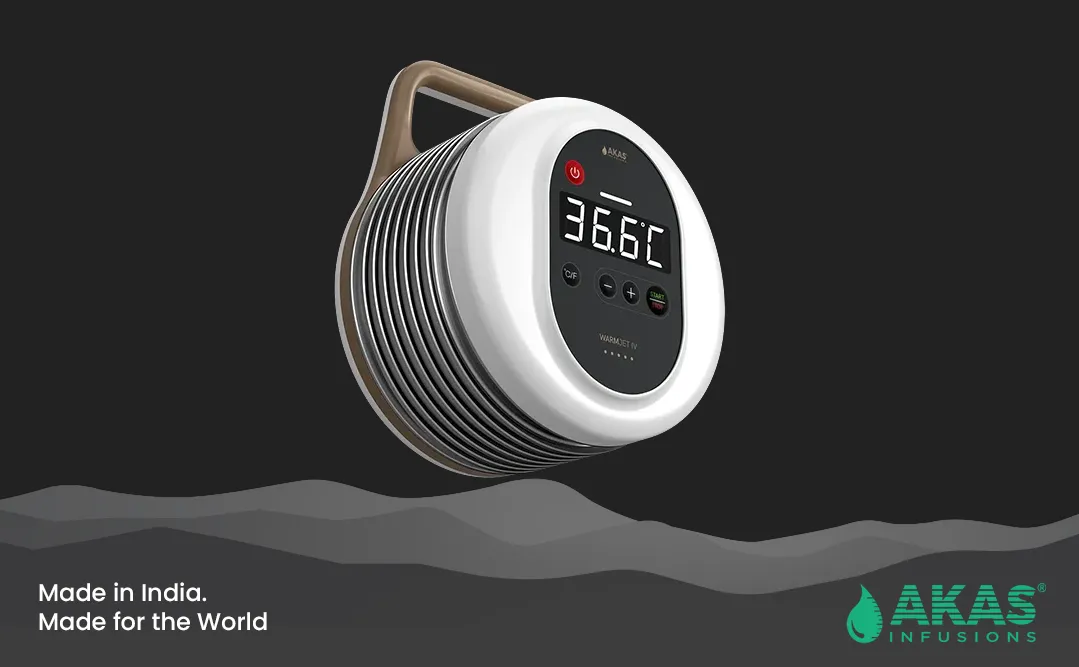
Challenges of Low-Flow Rate Infusions in Critical Care & How Fluid Warmers Solve Them
In critical care environments, every aspect of patient management matters, including the temperature of the fluids being administered. While significant attention is given to accurate drug dosing and infusion rates, the impact of fluid temperature during low-flow infusions is often underestimated. Patients in intensive care units (ICUs), neonatal intensive care units (NICUs), operating rooms, and emergency departments frequently receive medications and fluids at very low infusion rates, where even minor temperature variations can affect overall thermal stability.
One of the biggest challenges with low-flow infusions is that fluids spend more time travelling through IV lines, making them susceptible to heat loss before reaching the patient. For vulnerable populations such as neonates, trauma patients, and critically ill adults, this heat loss can contribute to unintended hypothermia and associated complications. This is where advanced fluid warming technology plays a crucial role.
In this article, we explore the key challenges of low-flow-rate infusion warming, why maintaining fluid temperature is essential in critical care, and how a specialised fluid warmer for low flow rates can help healthcare providers improve patient safety and support effective IV fluid warming in critical care settings.
Why Is Low-Flow Rate Infusion Warming Important in Critical Care?
In critical care settings, maintaining a patient’s core body temperature is as important as delivering medications accurately. Many critically ill patients receive intravenous fluids, blood products, or medications at very low infusion rates. While these therapies are essential, the temperature of the infused fluid is often overlooked.
When fluids travel slowly through IV lines, they can lose heat before reaching the patient. This can contribute to unintended hypothermia, especially in vulnerable patients such as neonates, trauma patients, surgical patients, and individuals in intensive care units (ICUs).
This is why low-flow-rate infusion warming has become an important component of modern patient temperature management strategies.
What Are Low-Flow-Rate Infusions?
Low-flow-rate infusions are intravenous therapies delivered at slow rates, often ranging from a few millilitres per hour to less than 100 mL per hour.
Common examples include:
- Vasopressor infusions
- Sedation medications
- Neonatal fluid therapy
- Pediatric drug administration
- Critical care medications
- Oncology treatments
- Cardiac care infusions
These therapies require precise delivery, making temperature management more challenging than with high-volume fluid administration.
The Main Challenges of Low-Flow Rate Infusions
1. Significant Heat Loss During Delivery
One of the biggest challenges is heat loss within the IV line. Because fluids move slowly, they remain exposed to room temperature for longer periods.
Even if fluids are initially warmed, they may cool significantly before entering the bloodstream.
2. Increased Risk of Hypothermia
Critically ill patients often have impaired temperature regulation. Repeated administration of cool fluids can lower core body temperature over time.
Clinical hypothermia may contribute to:
- Increased oxygen consumption
- Shivering and discomfort
- Cardiovascular stress
- Delayed recovery
- Additional metabolic burden
3. Longer IV Tubing Systems
Modern critical care environments frequently use extension lines, infusion pumps, and monitoring equipment. These longer fluid pathways increase the opportunity for thermal loss.
4. Vulnerable Patient Populations
Neonates and pediatric patients are particularly susceptible to temperature fluctuations due to their smaller body mass and limited ability to regulate heat.
For these patients, even small volumes of unwarmed fluids can have a measurable impact.
How Fluid Warmers for Low Flow Rates Help
A fluid warmer for low flow rates is designed to maintain fluid temperature during administration, even at minimal infusion rates.
Unlike traditional warming systems designed for rapid fluid delivery, low-flow warming technologies prioritise precision and consistency.
Consistent Temperature Maintenance
Modern fluid warmers continuously regulate fluid temperature, helping ensure that warmed fluids remain within the desired range until they reach the patient.
Better Support for Critical Care Applications
Specialised warming systems are engineered to perform effectively at lower infusion rates commonly used in:
- ICUs
- NICUs
- Operating rooms
- Emergency departments
- Cardiac care units
Enhanced Patient Safety
Many advanced fluid warmers include:
- Real-time temperature monitoring
- Automatic temperature regulation
- Built-in safety alarms
- Overheating protection mechanisms
These features help clinicians maintain safe operating conditions throughout therapy.
Benefits of IV Fluid Warming in Critical Care
Healthcare facilities increasingly recognise the value of IV fluid warming in critical care because it supports comprehensive temperature management protocols.
Key benefits include:
Improved Temperature Stability
Warmed fluids help reduce the risk of unintended temperature drops during treatment.
Better Support for High-Risk Patients
Neonates, trauma patients, and critically ill adults often benefit from more consistent temperature management.
Greater Clinical Confidence
Reliable warming technology allows healthcare providers to focus on therapy delivery while maintaining temperature control.
Integration with Modern Critical Care Workflows
Today’s fluid warming systems are designed to work alongside infusion pumps and other critical care equipment without disrupting clinical workflows.
Choosing the Right Fluid Warmer for Low Flow Rates
When evaluating warming solutions, healthcare providers should look for:
- Effective performance at low infusion rates
- Accurate temperature control
- Rapid response technology
- User-friendly operation
- Safety monitoring features
- Compatibility with critical care applications
The right system should deliver consistent warming performance without affecting medication administration accuracy.
Conclusion
Low-flow is a routine part of modern critical care, but they present unique challenges related to fluid temperature maintenance. Heat loss during slow IV administration can increase the risk of hypothermia and negatively impact vulnerable patients.
By using a specialised fluid warmer for low flow rates, healthcare facilities can improve temperature management, enhance patient safety, and support better clinical outcomes. As hospitals continue to prioritise patient-centred care, low-flow-rate infusion warming and effective IV fluid warming in critical care will remain essential components of advanced treatment protocols. With its advanced fluid warming solutions, AKAS Infusions continues to support healthcare providers in meeting these critical temperature management requirements.
Frequently Asked Questions (FAQs)
1. What is low-flow-rate infusion warming?
Low-flow-rate infusion warming is the process of maintaining the temperature of IV fluids and medications administered at slow infusion rates to help prevent heat loss and support patient temperature stability.
2. Why is fluid warming important in critical care?
Fluid warming helps reduce the risk of unintended hypothermia, particularly in critically ill patients, surgical patients, trauma patients, and neonates who are more vulnerable to temperature fluctuations.
3. Can low-flow infusions cause hypothermia?
Yes. Slow-moving fluids are more susceptible to heat loss as they travel through IV tubing. Over time, the repeated administration of cooler fluids may contribute to a gradual reduction in a patient’s core body temperature.
4. What is a fluid warmer for low flow rates?
A fluid warmer for low flow rates is a medical device specifically designed to maintain the temperature of fluids delivered at slow infusion speeds commonly used in critical care and neonatal settings.
5. Which patients benefit most from IV fluid warming?
Patients in intensive care units, neonatal intensive care units, operating rooms, emergency departments, and trauma care settings are among those who can benefit most from IV fluid warming.
5. How does IV fluid warming improve patient safety?
By helping maintain normothermia, fluid warming supports temperature stability and reduces the risk of hypothermia during treatment.